
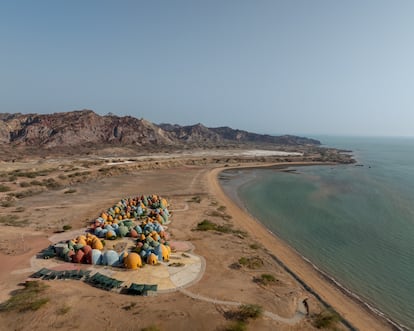
Until recently, the population of the island of Hormuz, in Iran, lived off fishing and illegal merchandise trafficking. Today, one fifth of the oil the world consumes annually passes through the Strait of Hormuz. The 6,000 people who live there have had to reinvent themselves. And they have done it by asking artists for help.
In 2008, a group of Iranian artists, led by Ali Rezvani, launched the Soil Carpet festival on the island of Hormuz to invite creators to play with the mountains and the colors of the local sands. The initiative was celebrated, but failed because the visitors had nowhere to spend the night. The architects of the ZAV studio proposed a solution on how to build without destroying.
The Majara residences are, in reality, interventions in the existing architecture. Conceived as a bridge for the progress of the place and for the relationship between visitors and locals, they built a cultural center and a pier.
To expand the accommodation, they designed small rooms in the way tanks are traditionally built to keep water fresh. Thus, they used the local construction method ‘superadobe’ based on applying layers of bags filled with local sand and very little cement to join them and give rigidity to the construction. Today, as an improvement, a steel structure, covered by cement, completes the facilities. The solution is economical, modern and at the same time traditional. Update the tradition. In addition, it has served as employment for those who know the tradition: local workers who, at the same time, updated their training to be able to build safer, faster and more economical buildings.
The Majara residence is today a complex of 200 domes, the vernacular structures to accumulate water have now been erected as temporary habitations. The spaces emulate the surrounding hills and are connected with patios and paths. There are rooms for 75 people and residences for 10 artists. The rest of the domes protect a public library, a restaurant and other services.
Based in Tehran, ZAV architects have already designed the Rong Cultural Center on the island itself and, a decade ago, the Orphanage for girls in Khansar. The set of rooms in Hormuz has received one of the Aga Kahn awards for best architecture for its ability to relate the geological context with control of new uses.
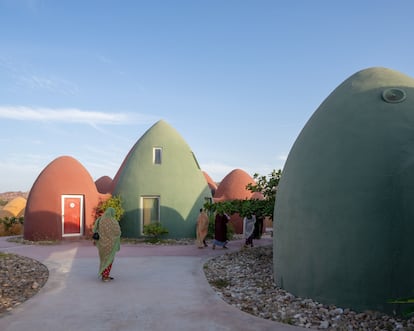
It is, once again, a proposal for change to avoid the great change: the transformation that is equivalent to a disappearance. Thus, the jury understood the initiative as an alternative to the global tourism model: open versus exclusive, an inclusive but limited framework that will not overload the energy limits or exceed the island’s water consumption. Therefore, the intervention is at the same time a response to a need, a limit to its exploitation and an update of tradition and therefore, a path to the future.