
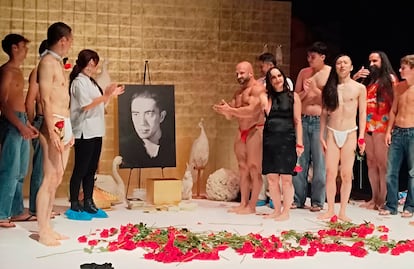
The appointment was at five in the morning this Saturday. A bus chartered by the organization of the Montaña Alta festival was waiting for its passengers in the center of Girona: journalists, critics and theater programmers arriving from different parts of Europe. They were arriving in small groups, camouflaged among other pedestrians coming out of clubs and clubs, but not in the mood for a drink but rather for a strong coffee. The objective was to get to the Teatre de Salt, on the outskirts of the city, to attend the premiere of Angélica Liddell’s new show, scheduled for a quarter to six.
The brand new winner of the National Theater Award, the most international Spanish creator and leading figure of the avant-garde scene, set the performance at that time so that the spectators would leave the theater at 7:45, coinciding with sunrise. It’s not a whim. The ancient Japanese samurai used to practice at dawn seppuku, the ritual ceremony prior to harakiri, which literally means “cutting the belly.” This is how the Japanese writer Yukio Mishima committed suicide in 1970, the source of inspiration for this work titled, precisely, Seppuku. Mishima’s funeral or the pleasure of dying.
Upon arriving at the Teatre de Salt, the cafeteria looked like a after hour full of clients. There were other programmers and journalists who had arrived on their own, but also people who had not gotten up early for work, but out of devotion to Angélica Liddell. On Wednesday, the director of the Montaña Alta festival, Narcís Puig, revealed that the tickets for the two scheduled performances (Saturday and Sunday at the same time) were sold out “in four minutes” and that the creator’s original idea was to hold the performance outdoors during dawn, but the weather in Girona on these dates made it advisable. Surely they would have sold the same. And he had barely revealed any prior information about the show or granted interviews. Amazing? No more than getting up at dawn to go climbing on a Sunday or listening to Rosalía’s new album before anyone else. Angélica Liddell has had a religion since long before Rosalía created hers.
The expectation for each new work by Liddell is always very high. In his works you can expect anything: he has self-harmed, gotten drunk, masturbated and really impaled himself. But on this occasion it was dizzying: not only because of the time of the performance, but also because of the taboo subject of suicide as the central axis of the work. To which we must add the uncomfortable figure of Mishima, currently claimed by the Japanese extreme right for his nationalist ideology and his defense of warmongering, just as the centenary of his birth marks.
Mishima’s voice can be heard in the background as the audience settles into their seats. It is the recording of a lecture that the writer gave at Waseda University in Tokyo in 1968, two years before his suicide: Where did the aesthetics of tragic destiny go? The work begins with the reading of a fragment of patriotism, short story by Mishima, which describes in detail the ritual suicide of its protagonist: “Using only his right hand, the lieutenant began to cut his belly from one side to the other. But as the blade became entangled in the insides, it was rejected outward by the soft resistance he found there.” It is staged by the dancer Ichiro Sugae and the actor Kazan Tachimoto with traditional Japanese theater movements before the gaze of Liddell, wrapped in a red kimono.
The scene sets the tone of the show from the beginning: violent but at the same time deeply lyrical, in an intimate and ceremonial atmosphere like the one that floats in the room of a person who is dying between life and death. During the performance, Liddell projects the photographs she took in 2010 when she imagined her suicide, how she would be dressed, in what position they would find her. He also says that last year he saw a woman jump into the void from a rooftop on Gran Vía. He recites names of deceased people and recounts the circumstances in which their deaths occurred (heart attack, suicide, overdose, cancer) while he puts on different clothes representative of each of them. He burns ashes that he claims are his parents’. Caress and kiss the smoke they generate with a thrilling tenderness. He brings two nurses on stage to draw blood from his veins and from the actor Kazan Tachimoto. Two spectators leave the room fainting. He masturbates with a calf’s liver.
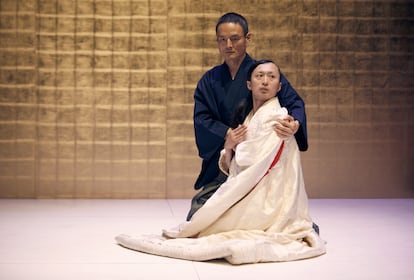
Death is the raw material that nourishes Mishima’s literary work and also all of Liddell’s shows since he began his career, more than three decades ago. “I consider everything from the perspective of my death. I don’t know how to live, I don’t know,” said the creator in an interview with EL PAÍS in 2021. But the death drive, at 59 years old, is increasingly stronger. Especially in his last two works, with which this Seppuku could make up a trilogy: Voodoo (3318) Blixen, a monumental montage in which his funeral was staged, premiered in 2023 on this same stage; Demon. Bergman’s funeralwhich opened the Avignon festival in 2024. In fact, a question he asked at the latter is repeated in the final monologue of Seppuku like a chorus: “When am I going to die?” And also: “I ask for the end of life.”
Liddell is twinned with Mishima on an aesthetic level. She invokes him from the stage, like a priestess, to confront her spectators with death. She invites them to get up at four in the morning to face her bareback and, in the process, strip the theatrical ceremony of any banal context. The audience responded with enthusiastic applause at the end. When we left, it was already dawn.
Big Bang
The premiere of Seppuku, which already has scheduled performances in Strasbourg, Vienna and the Grec festival in Barcelona, has been one of the highlights of the current edition of the Montaña Alta festival, which began on September 18 and runs until December 12. This week has been especially intense because the Big Bang was celebrated, with a high concentration of avant-garde shows that could be booked for tours, with the presence of a hundred national and international programmers. Among them, the latest creations by the Belgian Miet Warlop, the Argentine Marina Otero, the Catalan company Agrupación Señor Serrano and the duo Pau Matas-Oriol Pla have been seen.
The latter, who opened the cycle on Thursday with a marvelous exhibition of his acting skills in the show Gola, He got on a plane after the show to attend the International Emmy ceremony in Los Angeles this Monday, where he is competing for the best actor award for the series. I, addict, by Javier Giner.