
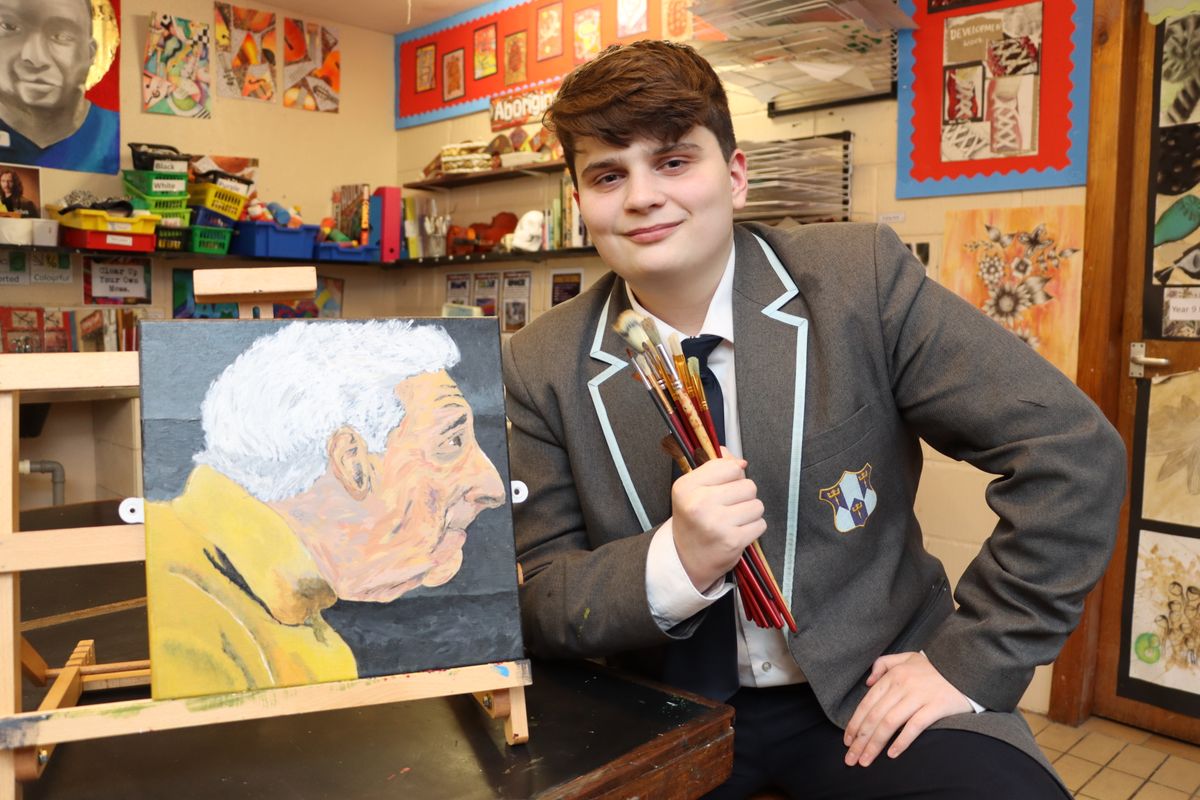
James Doyle, 14, won the 11-14 category with a striking acrylic portrait on canvas titled ‘Nosey Man’, competing against the highest number of entries across all three age groups. The achievement is particularly significant as this is the first award for a young artist in the RBSA’s more than 200-year history.
James created the winning painting at an art camp run by Korean artist Joohee Chun during summer vacation. Portrait of an Elderly Man demonstrates his detailed technique of building layers of acrylic paint over pencil drawings.
“I was amazed and very pleased when I found out I won,” James said. “It’s really helped me believe that maybe I’m as talented in art as everyone says I am.”
The win is especially significant because of James’ journey. When he started at Maple Hayes just over two years ago in Year 8, aged 12, he was described as “illiterate”, with a reading age of around six or seven. His self-confidence had been so undermined by his struggles in mainstream education that he barely attended school, often too eager to go in or only getting by for a few hours a day.
“James started school as a very confident child, but this gradually deteriorated to the point where he had very low self-esteem,” said Matt Doyle, James’ father. “Maple Hayes was recommended to us and it was the best decision we ever made.”
The change has been significant. James now has 100% school attendance and is meeting age-related reading expectations. “James is like a different kid and that happened quite quickly after he started at Maple Hayes,” said Mr Doyle. “He is now confident and able to try new things and not afraid of failure. Now his reading skills are quite good, he can access many other things more easily.”
Mrs Burchell-Fearn, James’ art teacher at Maple Hayes, has been instrumental in his talent. “James has shown extraordinary dedication and natural talent in his artwork,” said Fern. “Her ability to observe details and translate them into paintings is remarkable. We are incredibly proud to see her recognized in such a prestigious competition. This achievement shows that when children with dyslexia are given the right support and encouragement, they can excel in their areas of strength.”
Mrs Burchell-Fearn was thrilled to hear of James’ win and proudly displays a copy of her painting in the classroom.
Current RBSA President Ed Isaacs presented James with his first award certificate and gift cards to purchase more art supplies from Cass Art at an awards ceremony on the last day of the show in August. His painting had already been selected from a large number on display in a prestigious historic gallery in the West Midlands and included in the exhibition catalogue.
Kerry Oddy, James’ mother, praised the school’s holistic approach: “Maple Hayes has been an important part of James’ artistic talent. The school recognizes that dyslexic children often have strengths in creative and visual areas and actively encourages and develops these skills. I believe that Maple Hayes has a very diverse approach to education where all children have access to something.
James is now studying GCSE art and aiming for a high grade. Although she is not yet sure of a career in art, she is considering combining her love of art and design with her love of organizing, citing an interest in urban planning, architecture, or landscape architecture. She also enjoys cooking and gardening and grows her own vegetables.
Mrs Oddy’s advice to other parents of dyslexic children reflects the family’s experience: “We have always encouraged both of our dyslexic children to spend time at home doing things they love and are naturally good at. James showed real talent and loved creativity, making, cooking and crafts from an early age. When there are things he struggles with – art etc, we remind him of art etc.”
Founded in 1982 by Dr. Neville Brown and his wife Brenda, Maple Hayes Hall School has been at the forefront of dyslexia education for over four decades. The school uses a distinctive morphological approach to teaching, where visual icons are used to make connections between meaning and spelling, offering an alternative to traditional phonics-based teaching, which can prove challenging for dyslexic learners.