
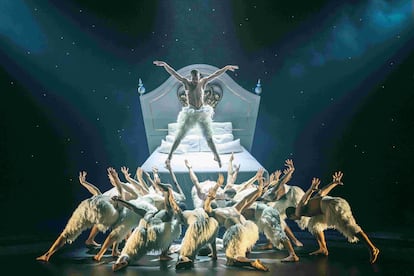
Swan Lake It is surely the dance classic that holds the most crowns and interpretations, all justified, at least for what it meant in its origins. Nothing seemed to foreshadow it in its first premiere in 1877 at the Bolshoi Theater in Moscow, when it turned out to be a total disaster because Pyotr Ilyich Tchaikovsky, composer of the music, and Julius Reisinger, author of the first choreography, did not understand each other. It was in 1895 when it premiered at the Mariinsky in Saint Petersburg, with choreography by Marius Petipa and Lev Ivanov, the moment in which Swan Lake It was born as a classic upon which adaptations have rained down.
One of them, the one staged by choreographer Matthew Bourne in 1995 at the head of his company New Adventures, and which he is now revisiting for its thirtieth anniversary, will be seen at the Teatro Real in Madrid from this Wednesday to Saturday. It is, without a doubt, the most well-known and revolutionary, at least at the time, due to the gender change of its protagonists. Those swans, crystallized into delicate ballerinas, archetypes of the most classic femininity, and that story of the most toxic romantic love between Siegfried and Odette, was dynamited by Bourne, who turned the swans into men and the story of heteronormative love into an open, gay relationship.
On November 9, 1995, the day of the premiere of this Lago, The queue to enter Sadler’s Wells in London went around the theatre. Word of mouth had spread at the same speed as the famous 32 whipped by Odile in the pas de deux of the black swan and Bourne’s version became a phenomenon. Seeing how the untouchable is dynamite also accompanies the reception of the classics. Critics and the public were divided between those who praised the work to the highest degree and those who wondered nostalgically where the poetry and the roots were (the thing about purity, which also goes with the classics).
The production was a complete success and featured in the longest season of a ballet in London. It also won the Olivier Award and five years later, in 2000, it went viral when it appeared in the final sequence of the film Billy Elliotby Stephen Daldry. Adam Cooper, the dancer in Bourne’s company, appears in the film in the role of Billy Elliot as an adult, turned professional dancer, whom his father goes to see perform. Thirty years later, this lago arrives in Madrid as a classic of that 1895 classic.
When his version premiered in London, Matthew Bourne clarified to The Independent that his intention was not to make a parody of the classic “because no one would dare to laugh at the swans.” But he was wrong. Since 1974, the hilarious (and also demanding) company Les Ballets Trockadero de Monte Carlo, who are not from Monte Carlo, but from New York, had been laughing at them. In Spain they have been programmed on several occasions and, both here and wherever they pass, their hooligan and comic vision of the classic, performed by men in female roles (with costumes, makeup and women’s accessories), usually sweeps away. At this time, the company has performances until June 2026, throughout the United States and Europe. From his entire repertoire, which includes classics such as Paquita y The nutcrackerhighlights the death of the swan, fragment of Swan Lake. A hilarious solo in which the transvestite dancer loses his feathers. Act II and Act II of Petipa’s iconic classic are also danced no three.
Beyond the gender change, Swan Lake It has been adapted taking into account other elements, such as the character of the characters. Such is the one constructed by the Swedish choreographer Mats Ek in his 1985 version, whose Siegfried is crossed by an Oedipus complex. By the way, in this adaptation of Ek, released ten years before the Bourne one, there were already men in the swan team.
The one by the Swede Alexander Ekman is one of the most impressive adaptations, at least visually, of those that have been made of this classic. Released in 2014 and structured in three parts (instead of the four acts of the original), the creator uses 5,000 liters of water on stage. Two years later, another Swedish creator, Fredrik Rydman, went to the street dance to tell the fairy tale.
Since the first versions by Michel Fokine in 1911 for Diaguilev’s Ballets Russes, those by Frederic Ashton (1963) for the Royal Ballet and John Cranko (1963) for the Stuttgart Ballet, the 1976 version by John Neumeier, that by Jean Christophe Maillot in 2011 and those already mentioned, the majority of the choreographers who have dared to modernize this classic have been men. There have also been, although many fewer and with less recognition. In 1985, the Spanish National Dance Company, when it was still called Ballet del Teatro Lírico Nacional and directed by María de Ávila, presented the second act of the work in a version by Alicia Alonso. Four years later, with Maya Plisetskaya at the head of the formation, the ballet returned to the Spanish stage in its original version by Petipa. Marcia Haydée presented her adaptation with the Santiago Ballet in 2009. More recently, Tamara Rojo premiered the version by choreographer Helgi Tomasson in 2024 at the head of the San Francisco Ballet, and Mar Aguiló presented a reflective version around the role of a classical dancer, in a contemporary key, in her work Swan (2023).