
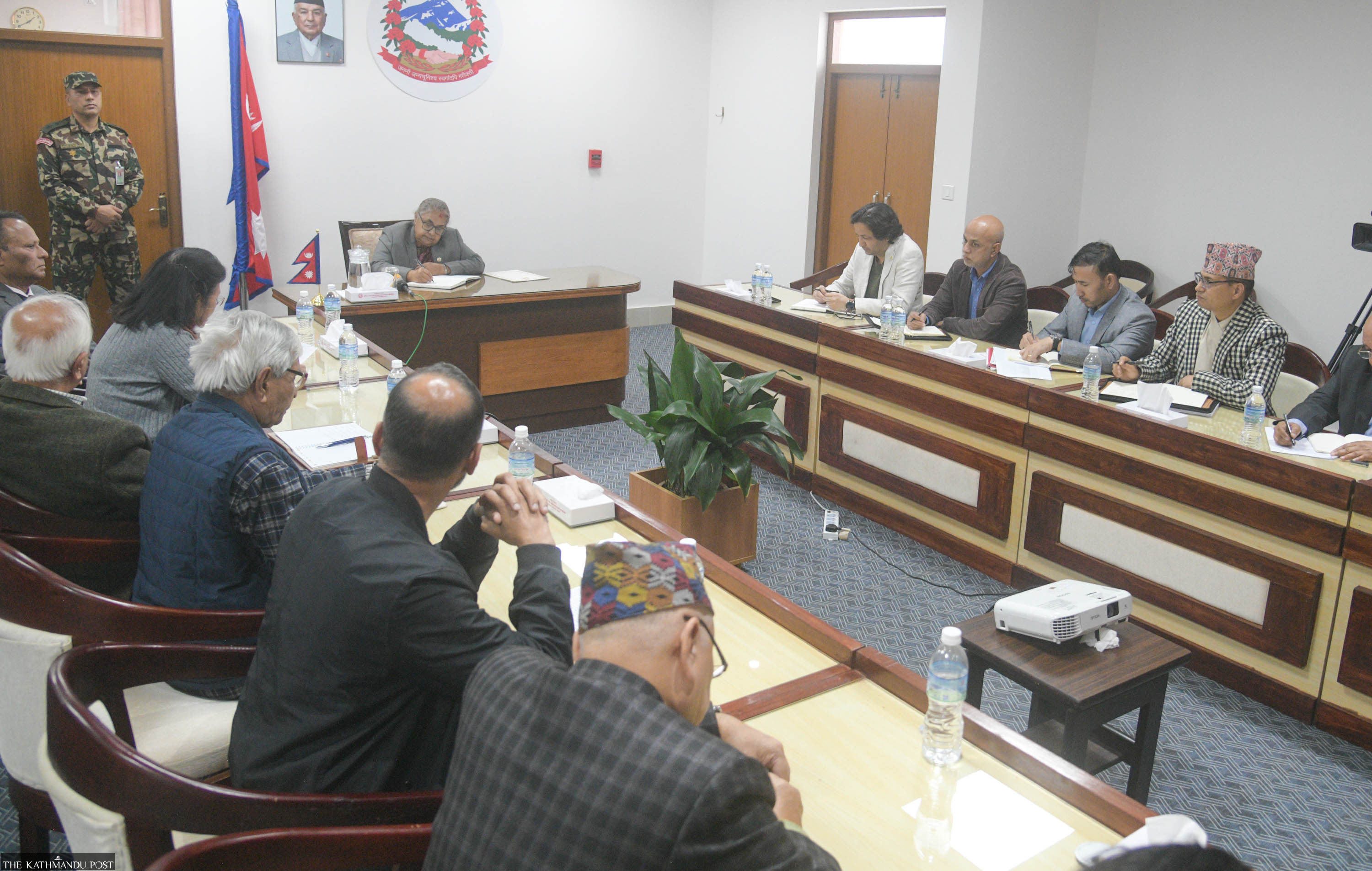
Chief Minister Sushila Karki has said that the registration of parties with the Election Commission by November 26 is crucial to ensure the March 5 elections. He described the deadline as a non-negotiable first step in terms of the credibility and constitutional legitimacy of the parliamentary elections.
Speaking to civil society members at the Singha Durbar on Monday, the Prime Minister stated that the first operational challenge to the constitutional impasse, according to a statement issued by the Prime Minister’s Office, is the participation of major parties in the election process.
He also endorsed the government’s efforts to fight corruption, saying at least 20 high-profile corruption cases have been opened, although progress remains limited due to the difficulties involved, according to one participant who spoke on condition of anonymity.
“We are in touch with the Commission for Investigation of Misconduct in Authority and the Central Crime Branch of the Nepal Police and are monitoring the progress every other day,” the participant told the Post, quoting Karki.
He also emphasized that the full participation of political parties is crucial for the elections.
“For the credibility of the elections, our first and mandatory demand is that the major parties must be registered with the Election Commission by November 26,” the statement said.
“The elections planned for March 5 are not just a political decision or preference of the current government. It is an inevitable national duty to prevent a constitutional vacuum. Despite the confusion caused by certain actors, I ask the civil society to stand firmly by the government’s side in strengthening the constitutional legitimacy of the elections and guiding democracy,” he said to see the right support environment for his civil society members. about future polls, according to the statement.
“At the moment, we face challenges on three big fronts: constitutional obligations, administrative capabilities and growing youth dissatisfaction. After fulfilling the constitutional requirement, the first operational challenge is the participation of major parties,” said Karki.
Despite assurances from the prime minister and the government, major parties remain skeptical of free and fair elections, citing continued mistrust and security risks after thousands of prisoners escaped from prisons during the September 9 protests and protesters looted police weapons.
About 15,000 prisoners had escaped, but many were recaptured and many more returned, but about 6,000 are still at large. Protesters also looted or stole more than 1,100 firearms. Although more than 700 have been found, the rest are still missing.
The Prime Minister assured that the government will work through the Track-II dialogue to build trust with the parties. “I am asking civil society to use its influence to bring all parties back into the process,” he added.
“Along with political risk management, we strictly focus on administrative preparations. We have a constant dialogue with the leadership of the Election Commission to make its operations more efficient. Our focus is on security and good governance. In order to make the elections more economical and efficient, we will closely monitor and prevent the unnecessary and bad recruitment seen in the previous elections,” he said.
Regarding the Z-generation movement, Karki clarified that it should not be seen only as a “law and order issue”.
“It is indicative of a deep political discontent with the system that has pushed some young people towards alternative governance narratives – a risk we fully understand,” he said.
“To win their trust and increase youth participation in elections, we are making structural reforms through electoral regulations and other measures that will provide political answers to their discontent,” the Prime Minister said.
Recently, at the Prime Minister’s request, the Election Commission extended the deadline for voter registration, and the registration of political parties with the commission is also speeding up.
“Along with managing youth discontent, we are alert to the risks of polarization and violence that can disrupt the election environment. Anyone who uses hateful or inflammatory speech during an election period will face immediate and public action from the relevant authorities. To ensure a peaceful vote, we have increased hotspot mapping and the use of intelligence. Citizen surveillance is more important than ever.”
The Prime Minister also called on civil society members to play and act as a bridge that provides political and electoral education to the youth in a language they understand so that they gain confidence in the principles, processes and systemic benefits of democratic governance.
“This systemic education is our strongest shield for democratic stability. The country’s democratic future and constitutional journey depend on the success of these elections,” he said.
“If we fail this time, the nation will be pushed into prolonged political uncertainty and constitutional crisis. As leaders of civil society, we count on you to play an active and decisive role as a third force – helping to build trust between government and political parties and encouraging public participation in elections.”
“I understand that when distrust grows among political parties, your role as an impartial voice – a third force – and a bridge that unites society becomes very important,” Karki said.