
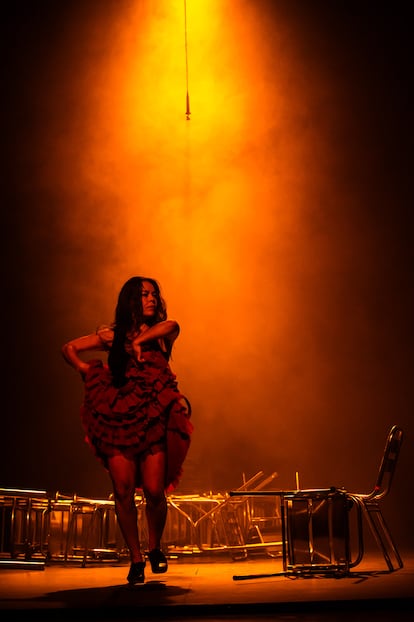
Don’t miss it. Because Heating It is one of those montages that is remembered for years or, possibly, for a lifetime. For a lot of reasons: Rocío Molina, the dancer and choreographer of the show, the main one. And as an example, what happened at the end of the show’s premiere this Saturday at the Matadero Dance Center in Madrid, which in reality has no end because the dancer continues her heels, already with the house lights on, while the audience understands that she must leave.
But the audience, all standing applauding, remained anchored to their places as if it were not possible to leave the place where those two hours of point-blank talent and spectacle had passed and, much less, leave their protagonist there, on stage, who continued clicking his heels. Then, as the room finally cleared and the spectators left their seats and walked towards the exit, with the stage and Molina to the right, the film director Pedro Almodóvar stood in front of it, knelt down and extended his hands. Molina, with an excited expression, continued doing his thing as if in a stage trance between exhaustion and plenitude. Almodóvar stood up after a few seconds, also overwhelmed by the two hours of stage event that had been experienced, and blew her a kiss. The dancer, without stopping the clicking of that foot board that she has been doing since she was 7 years old and that she explained at the beginning of the performance, smiled shyly. The end of Heating It seemed like a pilgrimage and Rocío Molina a figure whom it seemed impossible not to venerate as she passed.
In 2010, after showing his show old gold at the New York City Center, dance star Mikhail Baryshnikov also knelt before Rocío Molina backstage. Almodóvar, surely aware of this anecdote, chose to pay homage right there, where the scenic fascination had occurred and in front of the spectators who were leaving the room.
In Heating So many things happen, some almost unheard of, that it is not easy to face an analysis without committing spoiler. Of course, the event that overshadows everything is the dedication and clairvoyance of an artist who has reached truly transcendental places of creation and interpretation. She discovers herself as a dancer who continues to investigate body volumes from flamenco, but also as an actress, master of ceremonies and woman, in an exercise of extreme artistic demand and an intelligent and measured result. At times, the dancer’s face seemed different and it was even difficult to recognize her in that state of total dedication that she displays and that it is noticeable that she is in.
Although Molina had already worked with text in other shows, it is the first time that she clings to the word from beginning to end, while she dances and dances and dances, and makes jokes, with humor (“here I’m going to do a María Pagés, look at my arms”) and poetry (“I saw a woman enter with her lips painted red, a mouth that could devour itself”). And so the first 35 minutes of Heating and warm-up: with the dancer at the foot of the stage and light in the room, while she practices that foot plank that has accompanied her since she was a child and tells her method and anecdotes with microphone in hand without stopping clicking her heels. “If at any time this seems too long, you can leave without a problem. Where is the girl in the red coat?”
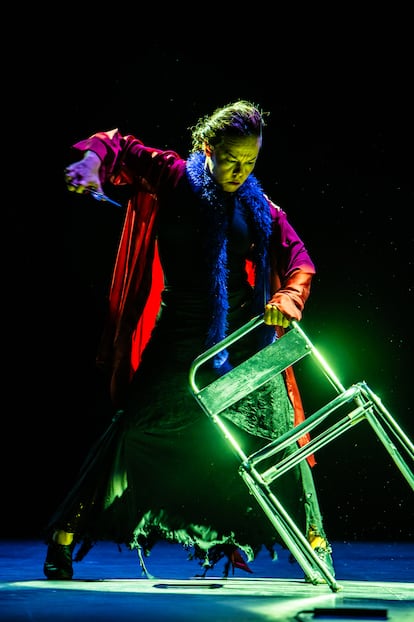
The person responsible for these texts and the co-direction of the show is Pablo Messiez, an Argentine author and stage director who has already demonstrated on many occasions the knowledge of working with dance and the exquisite practice that he usually weaves with movement. The sum of their credo together with that of the Cabosanroque collective in the scenic, Roberto Martínez in the costumes and Carlos Marquerie, who has designed really sharp, elegant lighting, structure and sustain a scenic apparatus in which everything adds up, everything counts, in a beauty that moves away from busy places to offer surprise and enchantment (those chairs that dance alone).
Special mention deserves the musical direction of Niño de Elche, who has composed an intimate and upcoming flamenco mosaic, with the gypsy-rock of the seventies of the last century as sourdough. The music of Las Grecas crosses the show in several ways. There is a very lucid containment in what could become a scattershot. But the importance of the minimum, when it is loaded with meaning, is key and successful. Musically and in the total bill of the show. The four fabulous singers (and actresses) who appear and disappear in a scenic, lighting and musical device, complete and condense with their presence and voices, that dramatic coherence that runs through Heating.
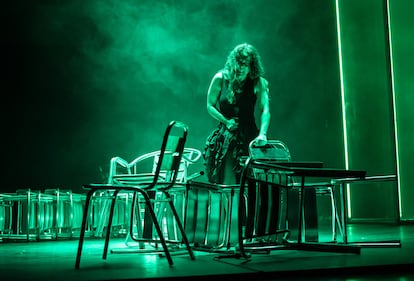
On a bodily level, Molina explores new twists and turns in that flamenco that twists and kneads from the deepest knowledge and the most authoritative freedom. And visit different corners where you can appreciate the heritage of Bob Fosse and the American cabaret and even Loie Fuller and his Serpertine dance. The metal chairs, present during the two hours (with a stellar performance in some moments and an overwhelming image in the final scene), also seem to pay tribute to the history of dance and recall, like subtle flashes, without insistence (another success), mythical scenes from choreographies such as ROSAS DANCES ROSAS de Anne Teresa De Keersmaeker y Café Müller de Pina Bausch.
Rocío Molina says that she doesn’t want the party to end, “if I don’t stop starting it means it won’t end,” and this statement reaches its climax towards the end, when the dancer crosses into techno with an (unusual) surprise included.
Warm-up can be seen at the Matadero Dance Center until next Sunday, November 23. If you go to see it (when you go to see it), carry a red flower in your pocket. I can count up to this point.