
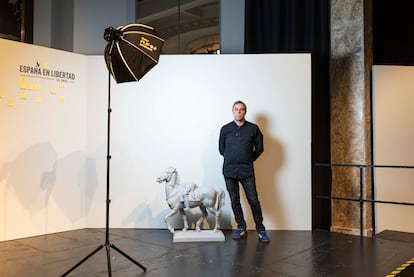
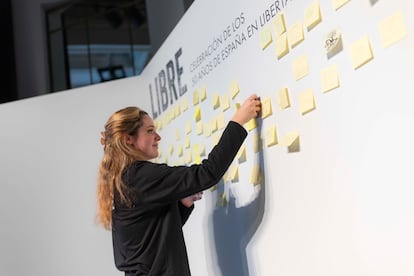
At the feet of Félix Villalba there are 25,000 horses. Walk around them before deciding on one. “Have they explained to you how it works?” they asked him upon entering the Column Room. “You can draw or write whatever you want about what you value most about life in a democracy and exchange it for one of the figures. One work of art for another.” The Sevillian stops in front of the wall where several have put their thoughts and writes on the sticky note, so small that it fits in the palm of his hand, just like the horses. Finally, catch one of them without a rider. Without Franco. The miniature—which represents the equestrian statue of the dictator who died 50 years ago—is engraved on the base: “Spain in Freedom.” And is part of Librean installation that commemorates the country’s half century of democracy.
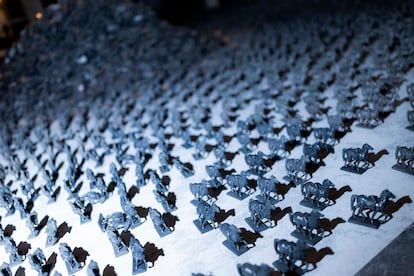
The fourth floor of the Círculo de Bellas Artes in Madrid is full of mixed generations: from children who write that freedom is “going on a skateboard with friends” to those who experienced the Transition firsthand. The words that are repeated most in the mural are “memory and democracy.” “50 years… it seems few to me,” reads one of the hundreds of papers. Among them is a drawing of the tricolor flag – red, yellow and purple – of the Second Republic, and current phrases such as “the truth is defended”, said by the State Attorney General from the bench. Each of these notes subtracts a weight from the two tons of horses that fill the room with that clean and synthetic smell that objects have just taken out of the package.
Nothing of the 25,000 horses in the room is left to chance. The artist responsible for the installation, Fernando Sánchez Castillo, explains that, if added together, their weight is equivalent to that of the last statue of the dictator, removed from Nuevos Ministerios in 2005: “Two tons of oppression.” “In this case, what I have done is keep the most wonderful part of the monument,” he says, while holding one of the miniatures in his hands. “The original sculptor hardly put any effort into the rider. It was almost a formality: a nose, a face, the eyes… he didn’t even completely resemble Franco. However, they all projected that figure of power, dominating the city and the public space.” He explains that his intention now is for citizens to have a perspective in which each one is the powerful one: “It is important to know what the toys of power are like and how they try or tried to control us.”
For Sánchez Castillo, exhibitions such as Libre “They are only important if everyone participates.” “If no one came, it wouldn’t be worth anything,” he says. He explains that the role of artists is often to act as mediators: “Connecting the past with the future.” In this specific case it is exactly that: “Where I was 50 years ago: I was playing.” The Madrid artist says that, at the age of five, he recreated Franco’s funeral with his toys. “Now, at 55, we are all playing together to imagine a better future,” he says. “Democratic memory should not be an exercise in nostalgia, but rather a living practice that is built every day among citizens,” and he adds: “If I had to leave something written today on the wall, I would say that I could be lucky enough to continue making liberating images for others.”
The night of November 19 remains alive in the memory of Félix Villalba. He tells it with a smile while participating in the same collective game that the exhibition proposes half a century later. At 18 years old, he attended a pre-university course while all the students thought that Franco had died days before. When the news came, it was “a liberation,” he says. “It was like starting a new stage… Those of us who were lifelong opponents… experienced a lot of repression.” Half a century later, he walks through the horse room and leaves his thoughts on the mural: “Freedom is the ability not to have any thoughts or ideas imposed on you by force.”
Now 68 years old, Villalba and his wife María Luisa Morales remember the two occasions in half a century when they have felt that democracy was in danger. The first was during the failed coup d’état led by Lieutenant Colonel Antonio Tejero. “The impression that 23-F made on me,” she says, “is that we were afraid again.” The second, she explains, is happening right now: “Young people are very far-right and it is because at school nothing was talked about Franco… So they have no idea of the repercussions that the dictatorship had and what it meant to enter democracy,” laments the woman from Extremadura. “They don’t have that assessment.”
That same concern is conveyed by Carmina Gustrán, commissioner of Spain in Libertad 50 años – promoted by the Ministry of Territorial Policy and Democratic Memory. “From the academy,” he says, “there is still lack of knowledge, and young people sometimes repeat wrong ideas about Franco’s regime, such as saying that under Franco people lived better.” Gustrán explains that three pillars are important to defend democracy: “Knowing the past, celebrating what we have and creating spaces to do so. The installation Libre —which opened on Saturday and will be open until nine pm this Sunday— works precisely as the latter. However, “a lot of work is needed in all three,” he points out.
There are thousands of horses that end up in the center of space, piled up to form a mountain of gray plastic. Around, the rest remain formed like an army, waiting for at least 25,000 people to leave their reflections on the mural. Visitors tour the place, write their thoughts and draw symbols of freedom. The little ones paint—with the help of their parents—the 80-gram statue in different colors and decorate it with glitter. Félix Villalba and María Luisa Morales make a final journey until they meet at the door. “We will give the horse to the granddaughter to play with. She loves them,” he says, and they go out into the rain of the capital.