
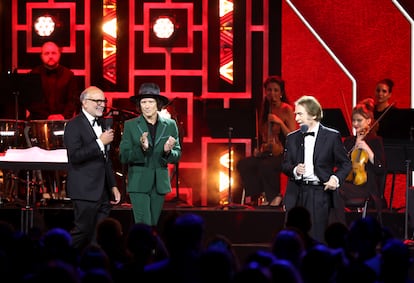
Raphael has been honored by the Latin Recording Academy (which awards the Latin Grammys) as Person of the Year in 2025. But, as Enrique Bunbury very correctly said when awarding him the award at the big gala, on his big night, before 1,100 people, “he could have been the person of the year of any year of any decade.” He was right, but this is a year special. Raphael, 82 years old, incombustible, multigenerational and suitable for any hyperbolic adjective, had to retire from music at the end of 2024 quickly and quickly due to the appearance of a brain tumor. Inexhaustible, he returned to the stage only six months later. But after a liver transplant, a tumor and at 82 years old, this tribute seemed to suit the singing boy from Linares, not so much a boy anymore, but just as a singer as always. And more excited, yes, than ever.
When, shortly before eight in the afternoon (Las Vegas, Nevada time; five in the morning, Spanish peninsular time), Raphael appeared on the stage of the Mandalay Hotel theater, there was applause. Respectful and light, welcome. With some help, the man from Jaén went down the stairs to sit at his table, surrounded by his family, saying hello. There, he put his hand to his ear, as if in a loving “hey, I want more.” When the gala is over, I don’t need to ask for it. The hotel theater was filled with applause, cheers and bravos to the artist, who after the tribute of artists such as David Bisbal, Silvia Pérez Cruz, Enrique Bunbury and Carín León, sang three songs, What does nobody know, my big night y how I love you.
The Latin Grammys — which will hold their annual awards ceremony on Thursday night — chose Raphael as Person of the Year for being “a great legend of Latin music.” “His musical career is a sign of his commitment,” said Manuel Abud, the CEO of the Latin Recording Academy. He already warned him: “You’re going to have a great time.” And so it was, although he reflected that pride and that journey with tears in his eyes, completely moved, performance after performance. Artists of all generations honored him with their songs and versions, demonstrating how Raphael has been able to connect with all types of audiences and countries, where they pay homage to him.
“Ladies and gentlemen, my name is Raphael Martos Martínez,” a very young Raphael started in a tribute video in which he told how he was always kicked out of school, but also that the person in charge of the choir rescued him time and again. Meanwhile, the artist’s face was seen on the screen, which showed him large throughout the night, reacting to videos, messages and performances. His eyes, glassy and trembling, showed his emotion, while they remembered his 350 gold records and the uranium record (he was the first artist to receive it), his films or his performances in the sixties in programs in the United States. All this without forgetting that the days his children were born were “the happiest days” of his life, along with his marriage to his wife, Natalia Figueroa; all of them were present in Las Vegas.
And after that, the performances. Enrique Bunbury began, dressed in an olive green suit, singing I am that oneaccompanied on stage by a string orchestra. Shortly after, the Mexican Carín León joined him to interpret Nowone of his hits from the eighties. Afterwards, the current king of the Mexican regional, who already has a great history in Las Vegas and will increase it in 2026 singing at the Esfera, continued with a beautiful version of Knock on wood.
Then the Café Quijano took the stage to sing How are you doing without me? with the Guatemalan singer-songwriter Gaby Moreno. They took over from Elena Rose and David Bisbal, dressed in sequins, who came together to make a melodic but powerful version of raw. Afterwards, the man from Almeria returned with how I love youone of the artist’s great classics that raised applause. His was one of the great moments of the night, going down to the table of the singer and his family to sit with them, pour a glass of wine and sing, looking into his eyes, each verse of his mythical song.
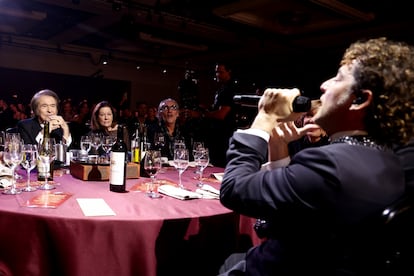
Bisbal wanted to have some affectionate and sincere words with a man whom he has often considered a mentor and an example. “The truth, Raphaelico —Rocío Jurado calls you Rapi, and I, Raphaelico— I don’t know what to tell you because I’ve told you everything. We have been friends for more than 25 years. Thank you very much for having left a legacy of discipline, effort, sacrifice, and absence. Because many times the absence of your family, of Natalia, is behind it,” he stated, moving Figueroa. “If that is the legacy you have left to the artists, you can count on me because I will always continue carrying your word,” he stated, moved. “There will never be anything like it. I love you very much, from the bottom of my heart.” After him came Iván Cornejo, another of the stars of the Mexican regional, who sang I close my eyes along with his compatriots Jesse and Joy.
Between songs there were recorded videos of artists thanking them for their careers or of Raphael himself, who assured that he had “many things not only to do, but to renew.” José Luis Perales or Manuel Alejandro chatted about their songs, Enrique Bunbury wondered “how he had the audacity” to have him, and explained that his way of working “only speaks of his interest in remaining relevant and for his songbook to continue evolving.” “I feel infinitely fortunate to have contributed modestly,” Bunbury said. Dani Martin said that it was a privilege that Raphael sang Peter Panone of his songs, while Pablo López assured that “producing an entire album” was one of the most powerful moments of his professional career.
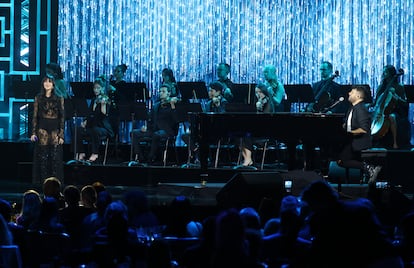
And there López arrived, on stage, to sing of so many peopleone of those songs composed and produced by him. The man from Malaga, at the piano and accompanied by violins, also sang his own I don’t want to runwhich he has sometimes performed with Raphael. Without letting go of the piano, Aitana arrived to sing together If you weren’t there. “You have been the soundtrack of my entire life,” said the 26-year-old Catalan artist. “It is an honor for me to be in front of you and your family singing this song,” said the young woman, until she burst into tears. López, for his part, expressed his love for him, and for his entire family: “Just to tell you something, friend, Mr. Martos: only love turns the scenario into a miracle, and that is you.”
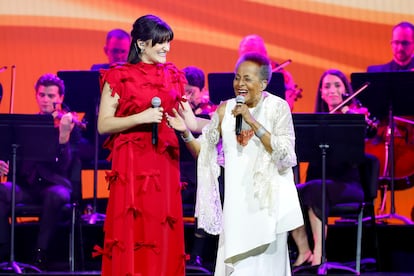
Behind him, The letter was played by Fito Páez on the piano and with tango airs, and then Rozalén arrived to accompany him, as well as to sing Chabuca Limeñaby Susana Baca. The Peruvian woman, barefoot, at 81 years old, was excited with the woman from Albacete, holding hands. Kikí Morente, along with her guitar, joined Ángeles Toledano for a powerful flamenco version of Whatever they sayaccompanied by Víctor Martínez’s guitar and timbales percussion.
Vanesa Martín talked about the composition of her song Every Septemberand how for her it was a tribute to the singer and his wife. Accompanied by Kany García and her electronic cello, the Puerto Rican and the Spanish sang together. “I am very excited to sing again with your eyes focused on what you like to do most, music”; Martin stated. “You have managed to pass the generation, that there is no geographical barrier, that there is no age. You have achieved what music has to achieve, that there is no type of brake or mental limits. I would clone you,” Martin laughed. “Thank you for encouraging us, because you have set the bar very high for us.” Martín finished off his appearance with Why don’t you goin its second part, with the elegant company of the Mexican Carlos Rivera, who described him as “a living example of what an artist with all his letters is.” “You said it, your mother gave birth to you as an artist. Well, long live the mother who gave birth to you,” he stated, to the laughter of the audience.
Other greats such as Julio Iglesias, El Puma, Adamo, Vicente Fernández or Miguel Bosé also appeared in old recordings and messages of affection. “You were the first,” Bosé stated, “no one can take that away from you. Blessed are you and blessed is the night in which all your songs, all your words, your entire career will resonate.” Miguel Ríos remembered how in the sixties, signing his first contract, he had the vision of bringing a photographer to photograph him.
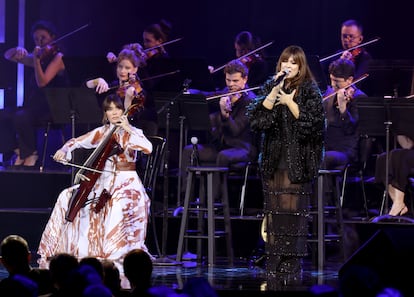
I try to forget youby Hernaldo Zúñiga but which Raphael has often covered, was sung as a symphonic bolero by Texan Pepe Aguilar and Chilean Myriam Hernandez. “It’s hard for me to contain my emotion because since I met you I told you that when I was four years old you inspired my music, it was the first concert my parents took me to, you sang the Hail Mary and I thought I was seeing the virgin,” Hernández was excited. “Master,” Aguilar told him, “that word fits so well to few people.”
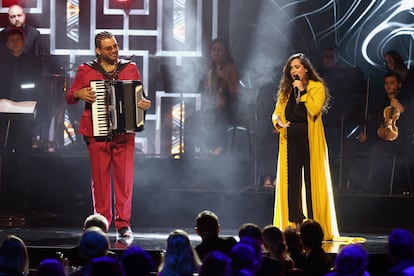
One of the most beautiful and delicate moments of the night came thanks to Silvia Pérez Cruz, who brought her crystalline voice along with Mestrinho’s bandoneon to perform We are and put the entire auditorium on edge. Then came the scandal and the Cariba. With Willy Chirino, Eddy Herrera and Víctor Manuelle, who came down to the family table while singing the famous Scandal and they made their friend Raphael, as they called him, party. “If I had a quarter of the talent that you have, I would be one of the greatest artists in the world,” said Manuelle. “No one in the world sings like you,” Chirino assured.
The end of the night, the last word, was the artist’s. Manuel Abud and Bunbury presented him with their award for his “countless and stratospheric achievements.” “Gold, platinum and uranium records complete the person and the character,” reflected the musician from Zaragoza. “A character because he interprets the songs as if his life depended on it. He is not only the great voice of Latin American music, he has known how to create a repertoire like tailored suits. He has never stopped recording, for more than 50 years. What is truly incredible is his adaptation to the times, his radar for new generations and to be relevant in all decades.”
Raphael himself, in words, had little else to contribute, other than thanking everyone for being there for “almost sixty-five years”: “You have made me the happiest person in the world. Thank you for understanding my songs and my art, if I have it, thank you for these wonderful years.” And of course, he closed by singing. And he left, with the biggest smile, and eyes full of emotion.