
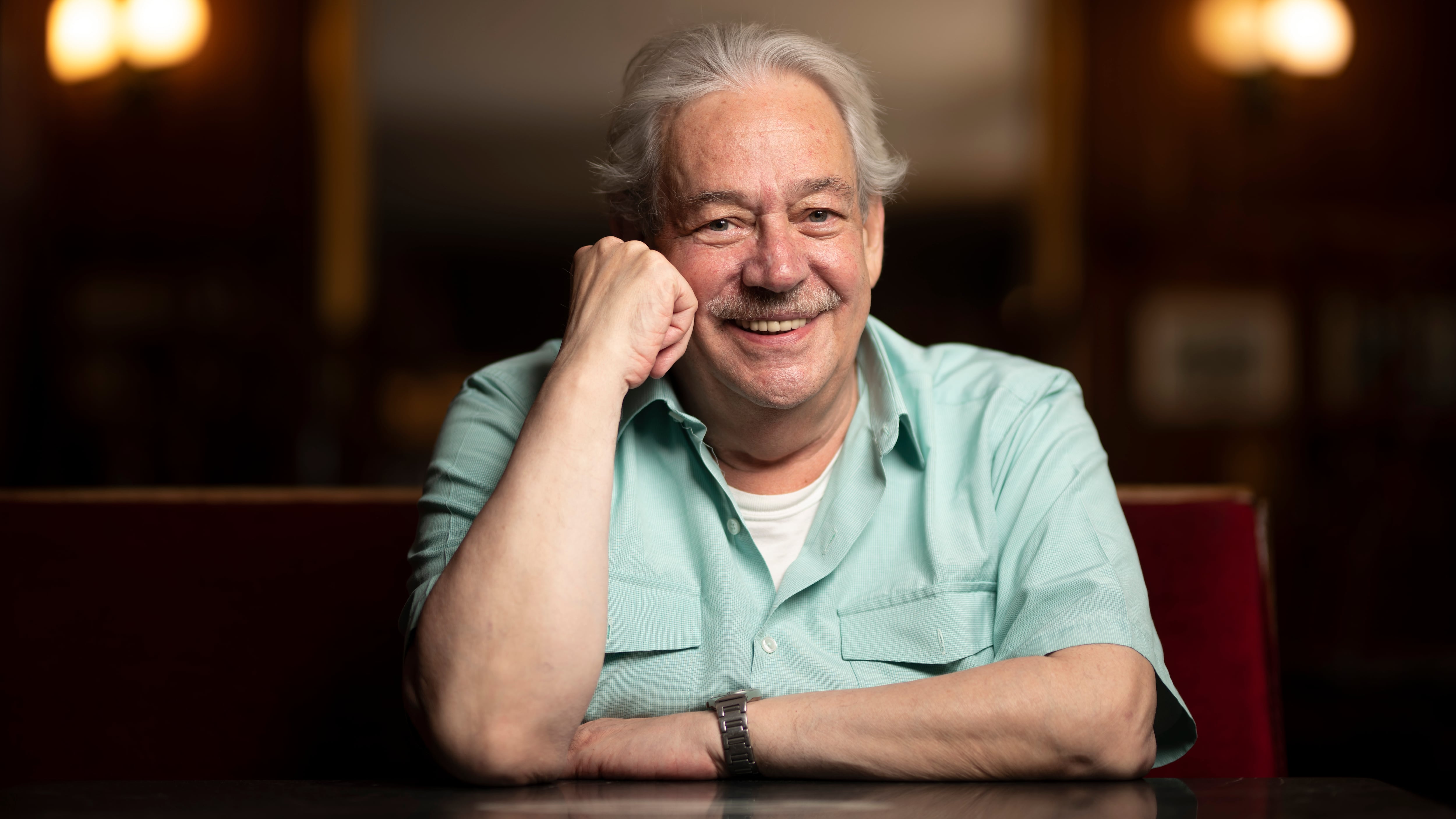
At the age of 12, Gonzalo Celorio (Mexico City, 77 years old), the current 2025 Cervantes Prize winner, bought his first book, the first to which he gave his name and signed it with his own handwriting, a book that gave stardom to his home library inclined towards the Spanish-American novel, but, above all, it was a declaration of love for the word. Essayist, narrator, professor at the Autonomous University of Mexico since 1974, where he was also a student at the Faculty of Philosophy and Letters, he has been director of the Economic Culture Fund and director of the Mexican Academy of Language. A man also interested in the history of words in Spanish, confirmed his love for them when he entered the Academy: “The words that define us and that make us transcend, the words that we inherited and that, revitalized, we will inherit, the words that we fell in love with and those that we will never be able to domesticate. Talking about words is as joyful as discussing the lengthy preparation of mole negro while rolling a formal tortilla in the palm of the hand; like pondering the prodigious attributes of the blue agave while sipping a tequila horse,” and that place from which he speaks, Spanish, is thought and written from Mexico.
Author of Self-love (1991), And the earth trembles its centers (1999), metal and slag (2014), The apostates (2020), one of my favorite books is Mexico, city of paper (1997), where Mexico City, immense, atrocious and unfathomable, is in constant change, the same as a person with all its complexity, unfathomable in its different and multiple stories from the Mexica in Tenochtitlán until the turn of the 20th century, a city possible only in the word, in its descriptions – such as those of Bernal Díaz del Castillo or Hernán Cortés – to the novels that portray it in the 20th century: “The history of Mexico City “It is the history of its successive destructions. Just as the colonial city overcame the pre-Hispanic city, the one that was formed in independent Mexico ended with that of the viceroyalty, and the post-revolutionary city, which is still being built, devastated the city of the 19th century and the first years of the 20th century, as if culture were not a thing of accumulation but of displacement.”
The fact that a Mexican writer, a Chilango writer, has won the Cervantes Prize, hopefully is an invitation to read his work and extends to the reading of other younger Mexican writers, now that the focus is on Mexico, as he says at the beginning of his book about this city: “My house, your house, as Mexican courtesy usually says to the confusion of foreign visitors, is nestled in one of the folds of the starched crinolines of Ajusco, in a town that has the grace to be called San Nicolás, and, in homage to the turkeys, called Totolapan.” A town that is part of the immense city of Mexico, like this beautiful book that is also part of an incredibly vibrant Mexican literary present.