
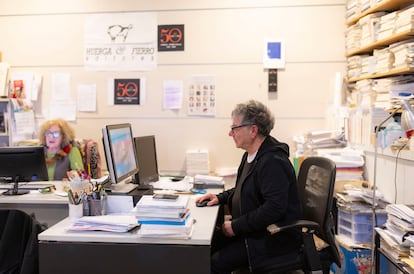
Antonio Huerga (Cartagena, 69 years old) was “a hairy hippie, he talked a lot, a snake charmer,” as Charo Fierro (Audanzas del Valle, León, 65 years old) remembers him. It was 50 years ago, when she met him and they founded a publishing house, around the time Franco died. Huerga, sitting next to him, continues to talk a lot and charm snakes, now wearing his hair short, although still in a style new wave Quite cool: “Then there was an explosion of creativity and ideologies,” he says. In that countercultural and anarchist breeding ground they began as Ediciones Libertarias; Since the nineties they have been Huerga & Fierro Editores.
—Are you anarchists?
—You can’t say that one is an anarchist!—they respond in chorus, as if it were something they had pointed out thousands of times.—You are or you are not, and in any case, others have to tell you that.
The connection between the two arises from a town in León, Audanzas del Valle, the town of Fierro and Huerga’s father, who went to Charo’s family’s house to give books to his brothers. “Some authors that we admire like Julio Llamazares, Antonio Colinas or Juan Carlos Mestre know the bucolic León, but we are people of the moor, of the most arid land,” says Fierro with a certain pride. But their meeting in the flesh happened in Madrid, between the university and that Rastro of the time that has become a mythological place. “Then they allowed books to be sold on the ground, combative books, as the mantle top with other products,” says Huerga. Pamphlets and fanzines (at least that’s what they would be called later) like those distributed by artists like Ceesepe, El Hortelano or Agus. “Or the Moebius Band!” adds Fierro, referring to the small publishing house underground of the time. Then, like everyone else, they went to have a drink at the La Bobia brewery.
La Movida: we do not agree on whether it was something transgressive or a celebration of the neoliberal hedonism of good children. “The Movida turned out well for me, even though so many have disowned it,” says Huerga. “Now there is a majority of youth who are not involved in anything,” adds Fierro. They say with true horror that they have received scholarships who do not know Federico García Lorca.
Huerga and Fierro have been editing for five decades, and not only editing, but maintaining a life project together in which they have raised five children. One of them, Óscar Antonio, works at the publishing house, another, Antonio Benicio, has his own: Los Libros del Mississippi. They belong, by the way, to the same generation as other projects that are now celebrating half a century, such as the poetry publishing house Hiperión or the Rafael Alberti bookstore. They receive at their headquarters, where the copies are piled up and have space for events, near the Embajadores roundabout, Madrid. There they tell their story in two voices that interrupt, contradict or complement each other, depending on the case. They continue fighting as a small independent publishing house born before there was so much talk about independence, which gives to everything, but with special affection to poetry. “We are orchestra editors, we know how to work in all positions,” says Fierro.
The anecdotes pile up. They visited the pool where Paco Umbral threw the books that he disliked, in his country house from Majadahonda. They attended Agustín García Calvo’s gatherings, even before they were held at the Ateneo, when they were in cafes like La Aurora or La Manuela. They witnessed, on the day he died, the inert body of Juan Benet. Leopoldo María Panero stopped by his office when he was on Gran Vía, sharing a flat with British Airways. All of them published in their editorial. Panero, in fact, left them a posthumous collection of poems, The lie is a flowerbefore dying in 2020.
Fernando Savater was also crucial, with up to five books, when he navigated the libertarian waters. “Now we do not agree ideologically with Savater, but he is still a friend: he was one of our great supporters,” they say. Those were different times: “Many times there was no need for a contract, we made a verbal agreement,” they remember. That was, of course, another Madrid. “There were no social networks, but we communicated like hell,” says Huerga, “before 200 people came to things, by word of mouth, now we don’t even get 10 together.”

The first books (more like pamphlets) from Ediciones Libertarias were The State and its creaturesby Savater, and Communities of Castile and May 68which established parallels between them, and which was a university work by Huerga (and which he signed as AJHM). He sold them in party areas such as Malasaña, Libertad or Huertas, for concerts, faculties and colleges. Then they cite as milestones, for example, the Nueva Narrativa Española collection: they began by launching 12 titles simultaneously, by authors such as Leopoldo Alas, Eduardo Haro Ivars, Lorenzo Silva or José Tono Martínez, with design by Alberto Corazón. Some of its authors later went on to successful careers at larger publishers. “We don’t mind being a springboard publisher, we are not going to compete with the big groups,” they say.
In poetry they published the magazine Signswhich Alas directed, and which later became his poetry collection, José Ángel Valente, Francisco Brines, Chantal Maillard, Javier Lostalé, Isla Correyero, Fernando Arrabal, Jorge Riechmann and Joan Brossa passed through that and other collections (they published the first ones outside of Catalonia). The photographer Ouka Leele, also linked to the Movida, had her own collection: Ouka Leele’s books. And they boast of audacity, for example, of the book Cocainefrom 1988, on the proper use of the drug, or the red school bookby Søren Hansen and Jesper Jensen, which encouraged children to challenge social norms from a Marxist approach: it taught them how to use drugs, how to have sex, or how to organize protests. The Nuestra Cultura imprint edition was hijacked and then edited by several publishers in response, including Ediciones Libertarias. His best seller It’s curious: The seven pillars of wisdom by TE Lawrence (aka Lawrence of Arabia).
In 1995, the editors looked for a capital partner to help improve the formal aspects of the project. The partner joined, but in just one year (from May 5 to May 5) the partnership broke up: the editors judged that they had lost control over the editorial line. So they followed the same path, but on a different path: the project was renamed Huerga & Fierro, taking advantage of the fortune that their two surnames sound very good together. “Financially, it was traumatic but the things as publishers were already in place,” says Fierro. “I do not agree with the word trauma“We already had the project in mind,” Huerga adds.
“Our big bet has been heterodoxy,” Huerga continues. “There are others who publish with a bow tie, it is better for us if they present us with a good text. If a text does not find a place in any other publisher, it is possible that it will find it with us. That is why they have never considered us serious.” They continue with projects: redesigning the poetry collection with Juan Carlos Mestre or editing Cesar Vallejo and Mary Shelley. 50 years later, of professional and personal life, do they leave a mark? “It is undeniable that wear occurs,” says Fierro. “But,” adds Huerga, “we are more excited than the first day and we never get discouraged, that’s our secret. The best is yet to come!”