
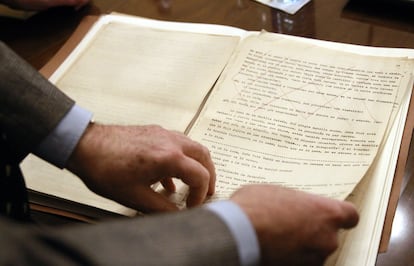
The hive It became an obsession for its author, Camilo José Cela (1916-2002). He worked on that work, now canonical, about that miserable post-war Madrid for six years, “correcting, polishing and rubbing, removing here, putting there and always suffering,” as he explained in the 1965 prologue. He fought on many fronts until he finally managed to get it to print, and he strongly insisted that the Franco authorities allow its publication and distribution in Spain. He achieved it first in Argentina in 1951 and, finally, in a Spanish edition in 1963, almost 20 years after having submitted a first version of the book to the censors. Now, the chance discovery, confirmed by the Ministry of Culture this week, of a first complete version from 1946 reviewed by the censorship adds a new piece to the complex puzzle surrounding the history of the work.
The historical figures in this convoluted literary and philological intrigue range from a civil censor close to Cela (Leopoldo Panero) and another Catholic (Father Andrés de Lucas Casla) to Argentine Peronist censors. Also to a French Hispanist member of the Communist Party and scholar of the Golden Age (Noël Salomon), and to a Barcelona publisher (Carlos F. Maristany), who ended up going bankrupt in 1949, but who hit the target with Cela’s first novel (Pascual Duarte’s family) and decided to bet heavily on this new work, he paid advances and planned a large print run.
The professor at Brooklyn College of the City University of New York Álex Alonso found this summer in the General Administration Archive (AGA) of Alcalá de Henares (Madrid) the typescript that Cela presented on January 7, 1946 to the Franco censorship to authorize the departure of The hive in Zodiaco editions by Carlos F. Maristany. Ten days later, in 1946, the writer’s only child was born. “Without the need to force things, it can be said, then, that the novel and I were twins growing up hand in hand,” writes Camilo José Cela Conde in a text included in the RAE’s commemorative edition of the novel in 2016. That same January, the authorities responded with a resounding no to the publication of the work: the civil censor did not show major objections, but the Catholic censor considered that it was “frankly immoral and sometimes pornographic and sometimes irreverent.”
Barely a month later, in February 1946, Cela once again insisted on the Government with his new novel, trying to get a deluxe edition of The hivethat is, fewer copies. The Galician also did some public readings and continued working on the text. After having published New adventures and misadventures of Lazarillo de Tormescritics and author friends encouraged him to focus his attention on the Madrid of that time. He thought of a trilogy, Uncertain pathsof which The hive It would be the first delivery. There were several titles for the book, obstacles from censors here and in Argentina, economic hardships. Cela himself worked as a magazine censor at that time, but that did not prevent his novel from being flatly rejected. Thus, in the history of that book we can see the portrait of a literary world held captive by a pacific and cruel dictatorship.
This summer Professor Alonso found the 1946 novel in a box that supposedly contained the censors’ 1953 report on the version of The Hive that had been published in Argentina and Cela was trying to get it authorized in Spain. It is a 100-page novel with censors’ markings and annotations, according to what he said. Eldiario.es, and Alonso himself explained in another article in that medium. “Two or three copies were presented and reviewed by a civil censor and a Catholic censor,” explains the professor, in a telephone conversation from New York.
One of those Cela typescripts sent to the censorship in 1946 was donated in 2014 to the National Library by the daughter of Noël Solomon, a French Hispanist who studied censorship in the theater of the Golden Age. It seems that he wanted to see some examples of Franco’s censorship to compare and that is why that first copy of The hive In the papers that his daughter donated, pages were missing and there were later additions by Cela, as explained by emeritus professor Adolfo Sotelo, the greatest specialist in the work of the Spanish Nobel Prize winner, who included that peculiar version of The hive in the RAE edition in 2016, published on the occasion of the author’s centenary. Sotelo points to the unknowns that still surround that copy of the novel (How did that incomplete typescript end up in Salomon’s hands? Why did Cela never claim it? Did he include scenes that he knew the censors would throw back, trusting that the body of the work could then be published?). Sotelo maintains that now the discovery of the unabridged version from 1946 will allow us to understand “how censorship proceeded” and understand that Francoism “was not monolithic.”
Professor Alonso, for his part, emphasizes that the discovered copy raises questions about why it was kept in a box from 1953. “The censorship was a little chaos, it was not a well-oiled machine and perhaps, at some point, all the reports and copies of The Hive and they rearranged them badly,” he proposes.
Be that as it may, the new discovery in Alcalá adds to the study of how Cela worked on his “city novel”, a book strongly influenced by the narrative technique of John Dos Passos and Manhattan Transfer. “The hive It is a ruthless post-war portrait, very modern; a book in which testimonial realism is advanced, the style that Cela will continue to develop in that vision of society as an anthill with thousands of voices,” highlights the critic Ignacio Echevarría, responsible for the publication of Cela’s novels on the Debolsillo imprint that are in circulation.
The version that the author considered good and that is the one in the bookstores is the one from 1962 included in the first volume of his Complete Works and that a year later it was published exempt. “This discovery is a curiosity, it has a philological value, it is a new layer, but it is not essential. To think that we have not read the authentic novel would be absurd, Cela was very attentive to his work and was aware of his own value, forgetfulness cannot be suspected in him,” says Echevarría.
Regarding Cela’s role as a magazine censor for the Ministry of Information and Tourism, the critic maintains that it was not something that really marked his career and figure. “In the 1940s one made a living in Spain however one could, and this was something like a civil servant. Cela was an unscrupulous man, a hustler, but censorship in Spain has become very inflated. The most serious thing of all is what was left unwritten, not what was crossed out,” says Echevarría, who adds that in translations of foreign literature changes by the censors have survived and have not yet been expunged.
Alonso warns, despite everything, that in the archive in Alcalá we must escape “the seduction of the red pencil”, and clarifies that the intervention of the censorship in the version of The hive of 1946 did not result in the loss of any substantive material of the work. Finally, says the discoverer of the first unabridged version of The hivewhat is important is the richness of the archive that houses works that many authors did not preserve. There is still much to rescue. “It is the cultural history of that time,” he concludes.