
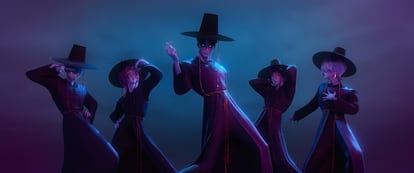
Like many parents around the world, Martín Tintxo Esnaola, 43 years old, made a costume for the youngest of her three children at the end of October. The k-pop warriors. The most watched movie in Netflix history was also the star of this Halloween. Girls, and not so girls, dressed as Rumi, Zoey and Mira, the heroines who crush demons while singing catchy Korean pop songs. But Esnaola’s was not just any costume. He put “lights and everything” on the sword and, above all, in addition to being the father of a fan, this man from Madrid born in Argentina worked as an animation supervisor on the Sony superhit.
Esnaola takes the video call in the basement of his house in Vancouver, where he has “the whole setup” (five monitors) set up for when he teleworks. Behind, a fabric printed with La ola de Kanagawa It covers washing machines and testifies to his fascination with Japanese aesthetics. He fell in love with his livelihood with Miyazaki’s films at Studio Ghibli (his favorite, Porco Rosso): “With them I understood that animation conveys fantasy and emotion in another way.” Classic anime fan Ghost in the shellthe visual spectacle of Arcane or the raw intimacy of I lost my body, studied animation in Madrid and online “when there were many fewer options for training than now,” he says.
His first job was at Real Madrid TV: “I had an ideal schedule and they paid well, but I wanted to entertain.” He worked in Los Angeles, London or Paris, until 2012 when he ended up at Imageworks, Sony Pictures’ animation and special effects studio in Canada. “When I joined we were a satellite of the headquarters in Los Angeles, but we have become the spearhead,” he says of Imageworks, where between 500 and 700 professionals work, but they can reach more than a thousand when, like now, it produces up to six or seven projects at the same time: “It’s crazy, but Canada has many incentives and we come out cheap.”
On his resume there are films as diverse as Hotel Transylvania (2012 y 2015), Emoji (2017), Spider-Man: Into the Spider-Verse (2018), The sea monster (2022) o in dreams (2025), which occurred before The k-pop warriors but it premieres, also on Netflix, on November 14. “When I interview people who want to work here, I explain to them that what I like most is that each film seems to be from a different studio; Disney or Illumination have great quality and great animations, but it gives the impression that they always make the same film. Our style is that we don’t have our own style and that allows you to innovate more.”
With the usual secrecy in the industry, the sequel to The k-pop warriorswhich Sony and Netflix are already negotiating, knows nothing. And the film he is working on, “an untitled project that is not yet announced for Netflix,” either. There he works as animation director (Head of Character Animation). What does the position entail? “In live-action cinema, the actors provide the appearance, the voice and the performance. On the other hand, in animation there are a lot of people involved in that interpretation. The characters are built in parts: actors who dub the voice, people who design the appearance, the riggers, who build the skeleton, the modelers… And at the end we enter the animators. Animating comes from anima: we are the ones who give soul to the characters, we fill them with life.” In that breathing of life we decide how the character moves, what gestures he or she makes, how the character is interpreted… Just as when in a set traditional yelling ‘Action!’ and magic happens, but in a much longer and more tedious process (an animator works on each film for around a year and a half).
The most difficult part of his job, says the head animator, is combining his vision (“what I would like to do”) with the vision of the film’s directors (“what they want to do”) and the producers (“what can be done”). “There are many meetings, many ideas back and forth, and also a lot of bureaucracy, because each step has to be approved.” All this with budgets that reach 100 million dollars (about 86 million euros) and templates as extensive as the credits of the films. Those of The k-pop warriors They last 14 minutes. “Tintxo Esnaola Scotto” appears after a minute and a half along with a version chibi (huge eyes and baby bodies) of the protagonists. In that first part of the credits “when it is still fun to stay and watch them because it is not just a succession of names,” he celebrates.
With so many people and so many phases, is there the atmosphere of a traditional shoot? “It’s a mix between that and an office job, you share space with people who are making other films, each one doing their own thing, there is no set…Although in more passionate projects, such as The k-pop warriors, Yes, a strong team feeling is generated,” says Esnaola, who admits that the story created and directed by Maggie Kang (who was, like him, an entertainer in the house) dazzled him from the beginning: “I started watching k-dramas and listening to a lot of k-pop, I wanted to absorb the culture so that everything would be very authentic.” He is “very proud” of the result: a film that was born small and has been embraced by the general public and praised by connoisseurs of the genre, precisely for its authenticity.
The scene that feels most appropriate in such a collective work is the last musical number by the Saja Boys. The group of boys, already transformed into demons, sing Your Idol in front of a dedicated stadium: “We reinvented part of the choreography and the camera shots, what we received was more traditional and we gave it the push to make it much more dynamic, more K-pop,” explains the entertainer, who delved into hundreds of video clips looking for movements and attitudes and adapting them so that the animation worked to the rhythm of the music, one of the stylistic keys of the film.

Esnaola, who among his work abroad included the Spanish co-production Planet 51 (2009), does not believe that he will return home soon. “That film was the first one with which we all thought, the industry was finally going to take off in Spain!… but it wasn’t entirely like that.” Lately he has received many resumes from Spaniards looking for work, he laments.
Around the world another danger lurks in the sector: artificial intelligence. “Is he topic right now, the talk…”, says Esnaola. “We don’t know if it will be a tool that helps us or one that replaces us. The advantage is that the big studios are as afraid as we are, it is easy for it to get out of hand: now they are the only ones who can make films of a certain level, but if AI democratizes production, they run a big risk. They are the first interested in controlling it.”